
Welcome to Charité: Information on recruiting international nursing professionals
Welcome to Charité!
An open and warm welcome culture for people of all backgrounds goes without saying for us. Our international colleagues enrich our diverse areas of work in nursing with their professional and intercultural skills and are an important part of our interprofessional team.
We are delighted that professionals from all over the world work at Charité – and perhaps you will soon be one of them. Our goal is for all employees to feel comfortable and well advised from the first contact to full integration, and to stay with us for the long term.
On this page, you will find all the important information about the immigration and recognition process. If you have any further questions, please do not hesitate to contact us at any time.
Company mission statement (statement of principles)
Protected seal of approval for fair recruitment
In order to promote internationalization in research, teaching, patient care, and administration, the hospital's board of directors has adopted an agenda for internationalization. One of the areas of action—international recruitment—combines measures to attract qualified nursing staff and retain them at Charité in the long term (p. 15f.).
In doing so, we are committed to fair and ethically acceptable recruitment practices in accordance with the six guiding principles:
- Written form
- Free of charge
- Limitation of economic risk for skilled workers
- Transparency (structures, services, costs)
- Sustainability/participation
- Overall responsibility for the service chain
In doing so, we adhere to the WHO Code of Practice on the International Recruitment of Health Personnel and the “employer pays” principle.
There are no costs for international nursing professionals involved in the placement process. As an employer, we expressly reserve the right to review our partners in accordance with the employer pays principle and at the same time secure contractual withdrawal options and special termination rights in the event that agreed conditions are not met or circumstances subsequently become known that make it unreasonable to continue the cooperation. There are no binding or repayment clauses in the employment contracts, and Charité undertakes not to arrange any employment relationships that contain binding or repayment clauses that violate the employer pays principle.
About the seal: We recruit transparently, fairly, and ethically! In Brazil, Chile, India, Colombia, Mexico, Turkey, and Tunisia, we recruit international nurses ourselves (without recruitment agencies).
As of November 2024
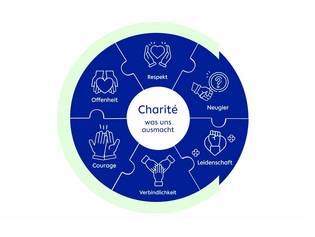
Our corporate values and guiding principle
Advantages of working at Charité
Further information material available for download
Professional recognition process
Guidelines
We are committed to the following guidelines and update them in accordance with the latest requirements.
Further information on professional practice for nurses
Immigration, recognition process, and integration support
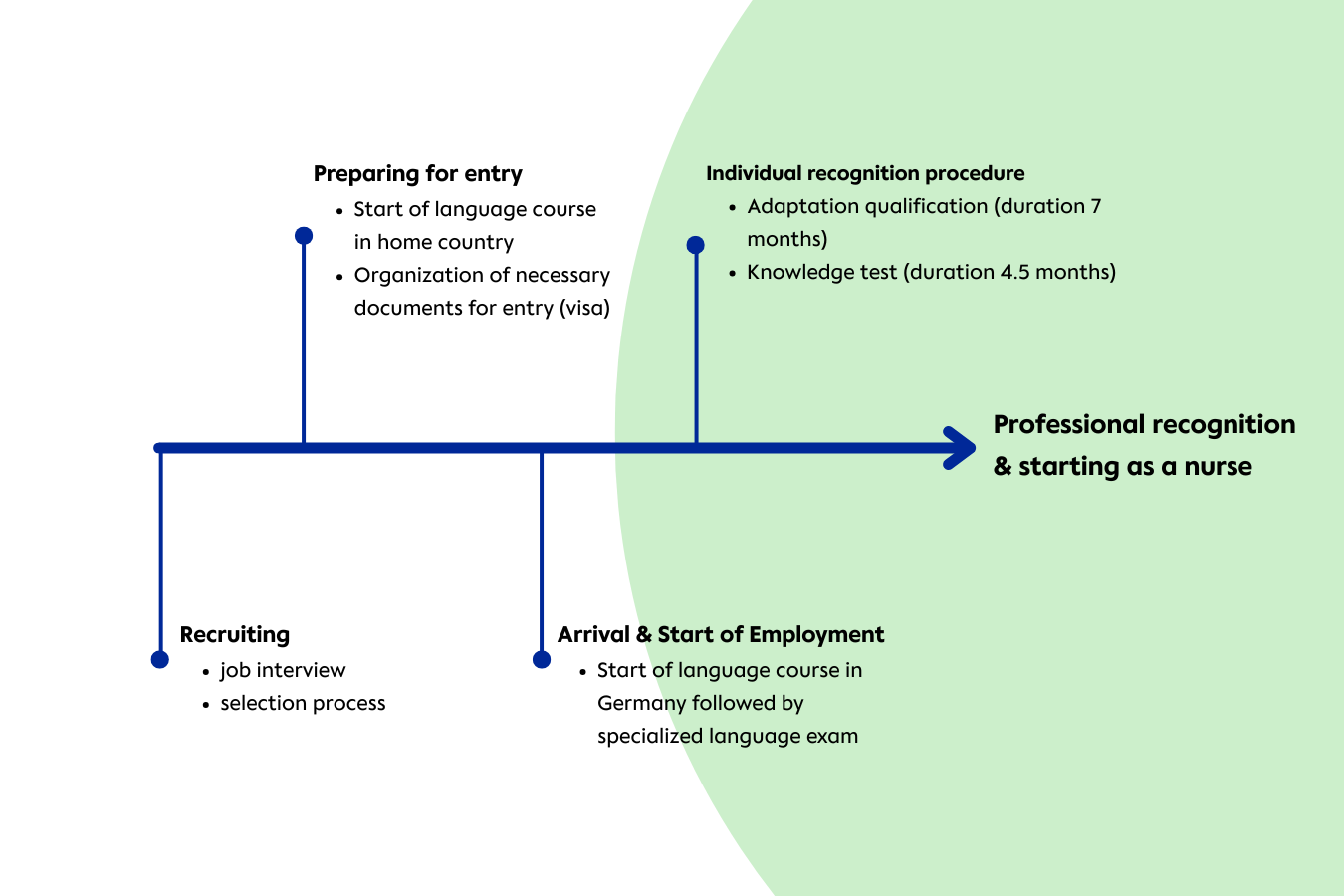
Before entering the country—and thus before the visa is issued—the application for professional recognition must be submitted to the relevant recognition authority (in Berlin, this is the State Office for Health and Social Affairs/LAGeSo) with all the necessary documents and details of the desired reference occupation (nursing specialist according to PflBG or health and nursing professional according to KrPflG). This process is supported by the ZAV (https://www.arbeitsagentur.de/vor-ort/zav/startseite) for recruitment in Mexico, for example, and by the DeFa (https://www.defa-agentur.de/) for recruitment in Brazil.
The LAGeSo (https://www.berlin.de/lageso/) then carries out an equivalence assessment. In the case of nursing qualifications from third countries, significant differences from the specified reference profession are often identified in an assessment notice. In such cases, the foreign professional qualification is not considered equivalent, meaning that differences must be compensated for by means of a compensatory measure in Germany (Section 16d of the Residence Act).
The missing content can be compensated for in an individually tailored adaptation course or a knowledge assessment test. At Charité, both adaptation measures are carried out in cooperation with the Berlin Education Campus for Health Professions (BBG) (https://www.bildungscampus-berlin.de/). The choice of the appropriate measure is made on an individual basis and depends on the linguistic and professional competence as well as the available capacity of the educational institution.
For internationally recruited specialist nurses, the length of their stay in Germany depends not only on their work situation, but also on whether they can feel at home in their new environment. It is about being able to follow and participate in social discourse in Germany, to participate in everyday public life, and to feel secure in the knowledge that they are welcome and belong. It is about friendships, good neighborhoods, and connections in the community and region.
Information from the Federal Office for Migration and Refugees for immigrants from third countries
Federal Government Information Portal on the Recognition of Foreign Professional Qualifications in Germany
Information from the Berlin State Office for Health and Social Affairs on the recognition of foreign healthcare professions outside the European Union
Information on economic migration to Germany for work in the care sector
Federal Government portal for skilled workers from abroad
Consulting services offered by the federal government
Language acquisition
German language skills – important not only for professional certification
For regulated nursing professions in Germany, proof of German language proficiency at level B2 according to the CEFR reference framework and, from 2021, proof of technical language skills are also required in order to obtain a license to use the professional title or a license to practice the profession.
For Charité, language instruction in the home country is provided by certified language schools. Participants receive free German lessons up to the B2 language exam. Integrated language support is provided during the adaptation program. Here, a language instructor and a subject-specific instructor collaborate to design the lessons, and special focus can be placed on practical technical language skills.
Professional and trade associations and employee representation at Charité
Training, continuing education, and professional development opportunities, collective bargaining agreement
Further advice and contact points
Complaint management
If you have a concern, feedback, or complaint, the usual contact persons from the integration team are available to assist you at any time. Your comments are important to us and will be carefully reviewed and processed in accordance with the established guidelines of our internal complaint management system.
The handling of your request will be carried out promptly, but no later than three weeks. The staff unit team is available to receive and clarify complaints:
Contact
Do you have any questions? We look forward to hearing from you!
integrationsmanagement-pflege@charite.de